

Only Allah Knows The Truth
By Anzar Lateef


Allahu A’lam. God knows best. This phrase has ornamented texts encompassing various genres written throughout the history of Islamic Civilization. Jurists, Theologians, and Philosophers would decorate their works with this phrase, appending it to a position they viewed as the truth. But this phrase always succeeded their truth because they affirmed that only Allah knows The Truth.
The Origins of Theological Discussions
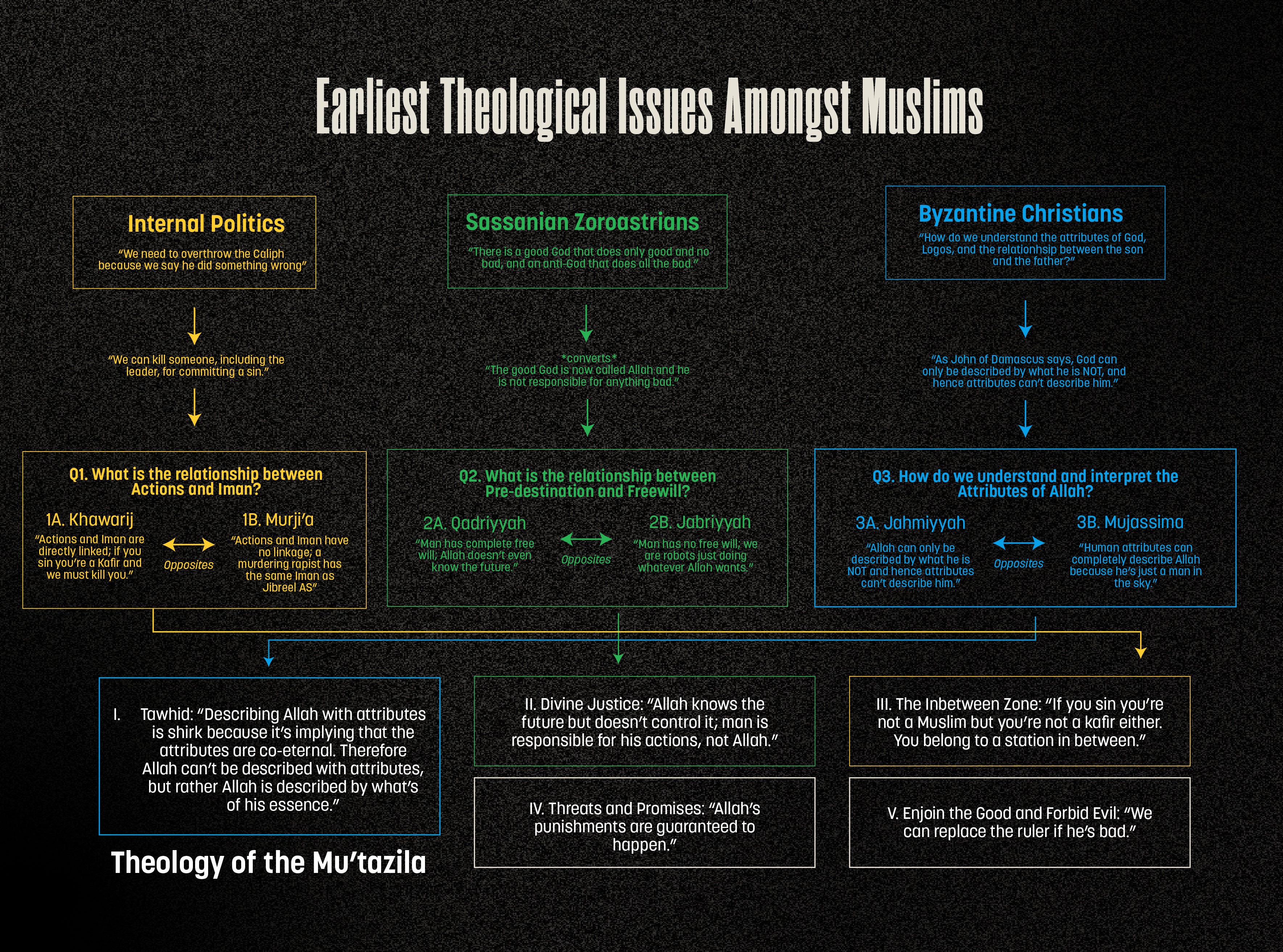
In the early decades following Prophetic revelation, the Muslim armies expanded westward into Roman land and eastward into Persian land, and they faced internal political struggles amongst themselves. These experiences led to new proto-sects emerging and an opposing counter-sect, revolving around a specific question of discussion, taking opposing positions.
The internal politics during the time of Ali RA led to the formation of the Khawarij, who revolved around the relationship between action and Iman, believing in a direct correlation, with sins making you into a disbeliever that must be killed. As a reaction to them, the Murji’a formed with the opposing position that actions and Iman were entirely unrelated.
In the Persian lands to the East, the influence of converts from Zoroastrianism caused new conceptions of Allah based upon their conceptions of Ohrmazd, the God of Good, and the Qadriyyah formed, revolving around the question of Freewill vs Predestination, taking the position that man is entirely responsible of his own actions and that Allah doesn’t even know the future. The Jabriyyah formed in response, taking the opposing position that we have no agency, and that men are simply robots fulfilling whatever was written by Allah.
Meanwhile, in the West, the Roman Christians were discussing the nature of Logos and the relationship between Jesus and God, and this caused a discussion amongst Muslims regarding the attributes of God. The Jahmiyya came forth positing that Allah can only be described by what he is not, and hence attributes can’t describe him. The Mujassima emerged in opposition, positing that Human attributes can completely describe Allah, because, from their perspective, God is just a man in the sky.
Due to politics, religious conversion, and religious dialogue, the Muslims started asking three questions: Firstly, on the relationship between Actions and Iman; secondly, on the relationship between Freewill and Predestination; and Thirdly, on the Attributes of God. Each of these three questions had two proto-sects taking opposing positions, and thus the Mu’tazila came forth trying to answer these three questions without falling for the three extremes. However, the proto-Sunnis disagreed with the Mu’tazili answers and tried to formulate their own answers, resulting in clusters which crystallized into the three Sunni Credal Schools: Atharis, Ash’aris, and Maturidis. Meanwhile, the Mu’tazili positions they were responding to have been adopted and further developed by the Twelvers, Zaydis, and Ibaḍis. However, what the Mu’tazila share in common with all three Sunni Credal Schools is the belief that their human answers to human questions resulting from human experiences are the truth, but that Allah knows the whole truth.

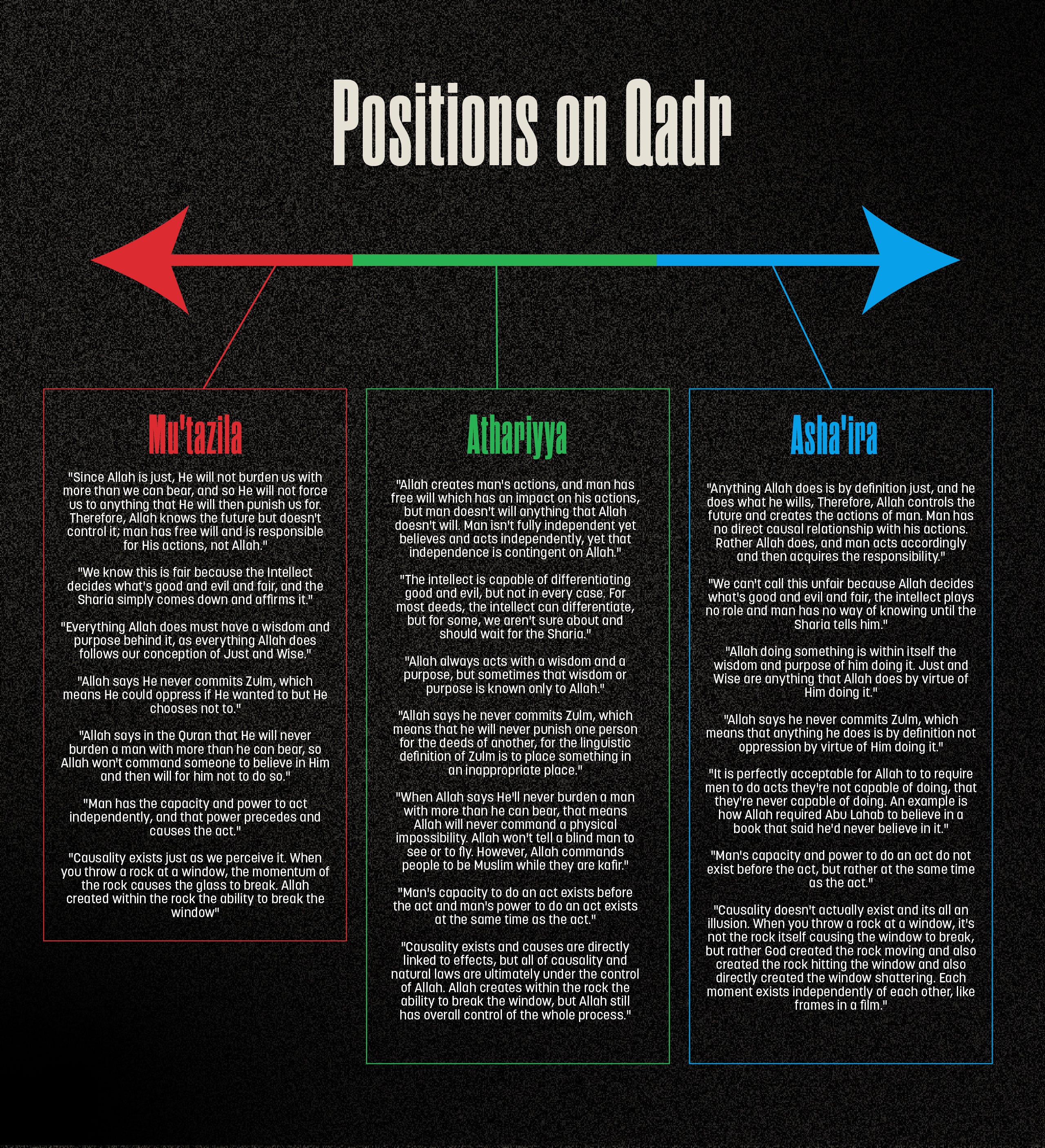
Instead, it could be posited that these human answers to human questions resulting from human experiences are human interpretations of an objective truth, and that objective truth is known to none other than Allah. Only Allah knows what his attributes really mean, or how qadr actually works, for the human mind is incapable of even grasping these concepts. The majesty of Allah is beyond our experience, and hence it is safe to say that only Allah knows the truth, and he revealed it to us through his Prophet, but that’s only a cross-section of the whole objective truth, and we are attempting to reconstruct an objective truth that we can never truly comprehend, that is beyond not only our capability of thought, but our capacity of existence.
Flatland
In 1884, Edwin Abbott wrote the story of a square that resides in a two-dimensional world, called Flatland. Flatland is a singular plane of existence populated by a variety of polygons and line segments, none of whom can even comprehend the third dimension, and deny its existence. Abbott describes the square protagonist’s interaction with a three-dimensional sphere that resides beyond his entire existence. The sphere was speaking from an unknown direction of “up” that was beyond the experiences of any flatland, that they’d deny its very existence. The square would feel that the spheres voice was a symptom of insanity, and when the sphere tries to enter flatland, the square would only see two-dimensional cross-section of the three-dimensional sphere, a cross-section that the plane of flatland intersects with, making the sphere appear as a shapeshifter that appeared out of nowhere, showed himself as a series of circles increasing then decreasing in size, and then disappearing. The two-dimensional square would have trouble understanding the very concept of a three-dimensional creature, but he’d know that there was a concept. However, his existence is too limited to understand the very concept of the third dimension.
The square’s perspective of his world is as a line. Abbott writes that they viewed depth through differing brightnesses, with closer objects having a different brightness than further objects. So, imagine the square and his friend viewing an equilateral triangle from two opposing viewpoints. The square views him directly from his angle, essentially seeing two sides with the angle in the middle. His friend sees him from the side, where the triangle would resemble a line segment. Their vision of the same triangle would appear as different. However, the sphere would be able to view from outside their plane of existence, and hence can objectively see that it is in fact a triangle, he can not only see every side of him, he can see inside him as well. The flatlanders were two-dimensional creatures with a one-dimensional vision, and likewise the sphere is a three-dimensional creature with a two-dimensional vision. If the sphere and his friend were to look at a Cone, with the sphere seeing it from the bottom and the friend seeing it from the side, the sphere would see a circle and the friend would see a triangle. The same three-dimensional object would be seen as different two-dimensional shapes from different angles of vision. Only a creature from a higher dimension would be able to observe the entire Cone, observing not only every angle of the outside but of the inside as well.
What the experience of the square in flatland demonstrates is that a view of the world is limited by experiences. He can not truly comprehend the sphere in its three-dimensional existence because his entire existence is two-dimensional. The square can only truly comprehend a series of circles, or at least his one-dimensional view of it. And if the square tried to reconstruct the sphere within his own limitations, what would result may be any two-dimensional shape, but it will not be a three-dimensional sphere. This applies to all of our capacity of knowledge.
Understanding Truth
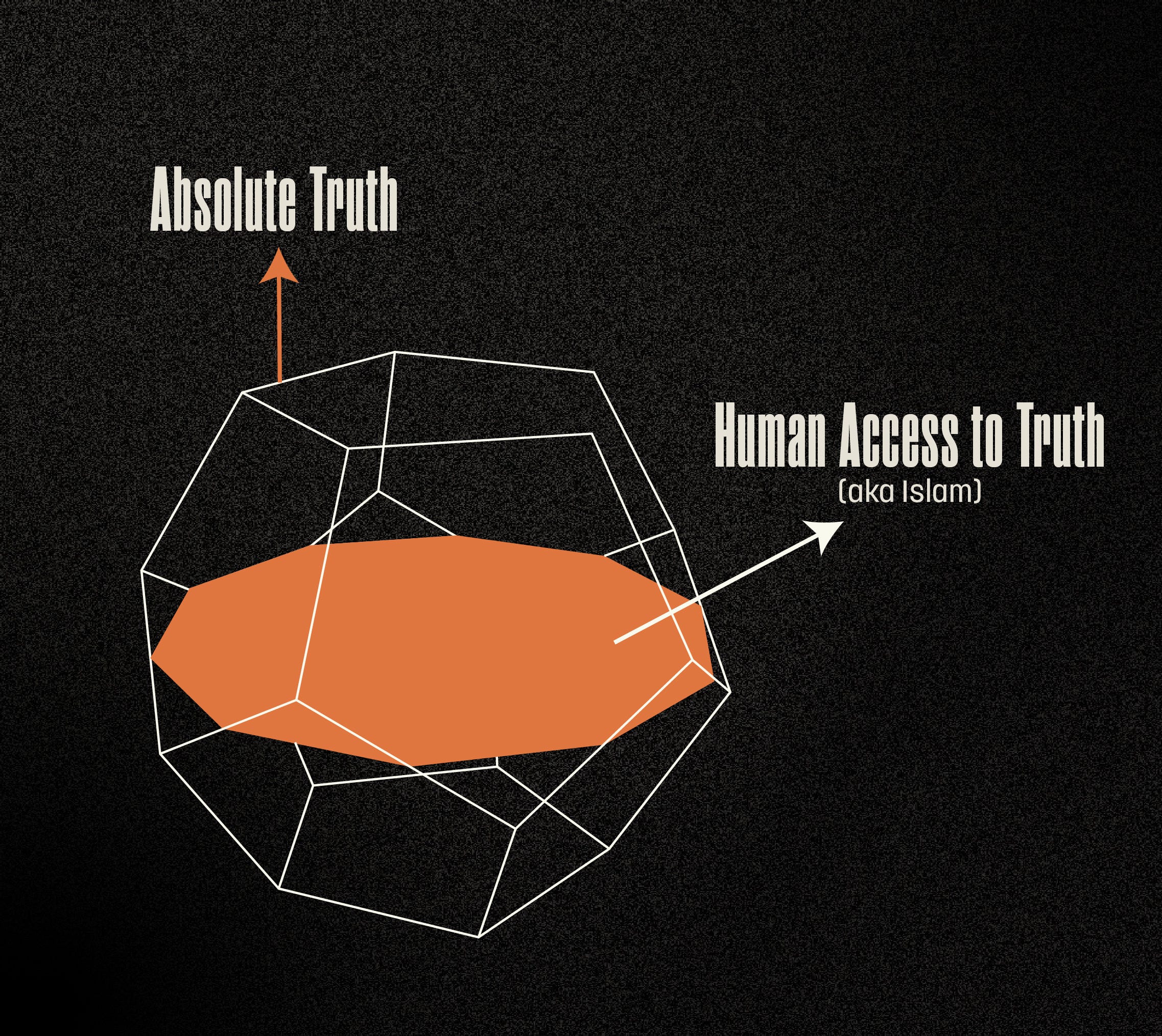
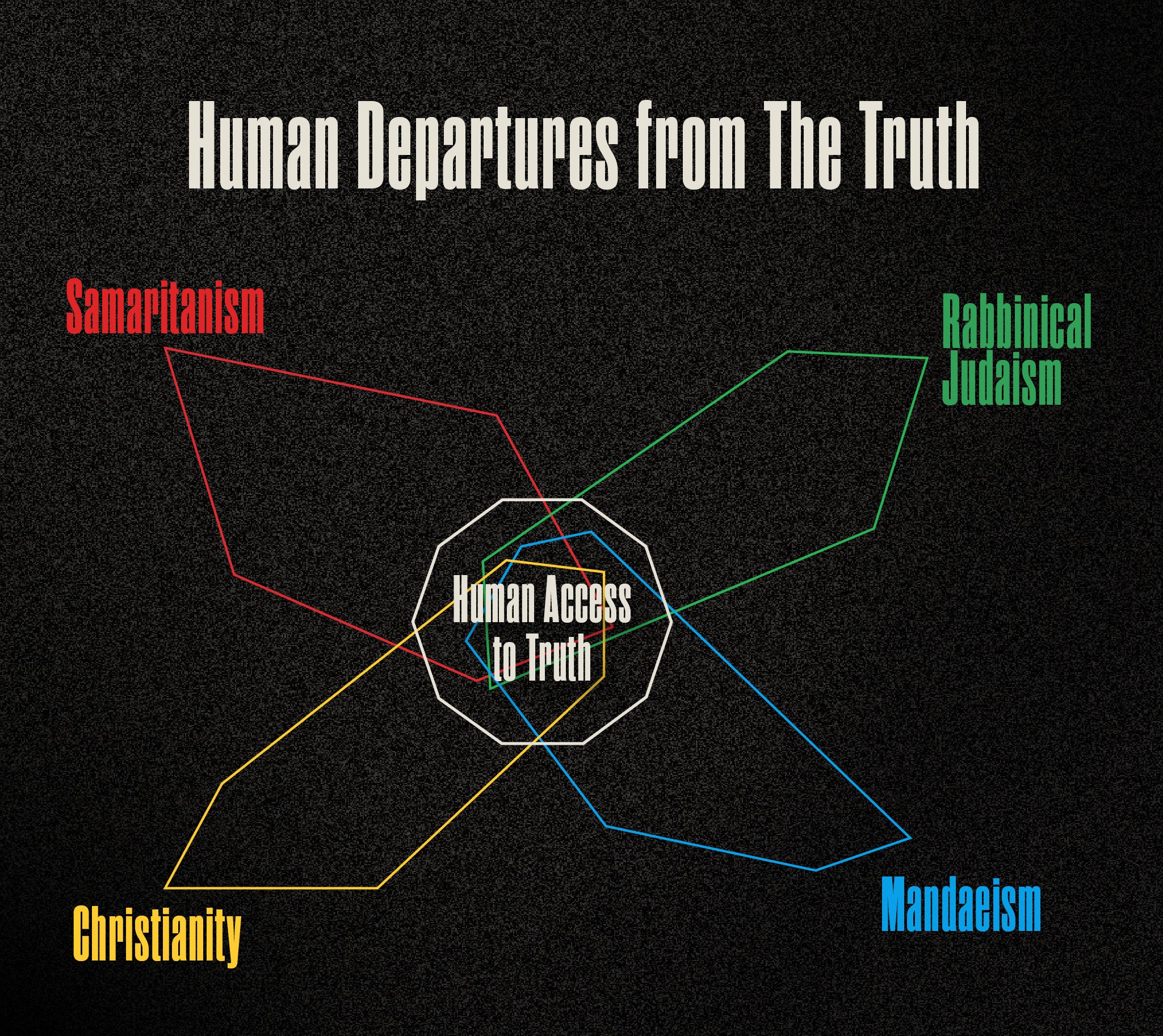
Now picture our human knowledge as two-dimensional and the Truth as three-dimensional. Let’s imagine Truth as a dodecahedron, a polyhedron with twelve pentagonal faces. A dodecahedron entering flatland could result in a variety of cross-sections, whether a pentagon, a hexagon, or perhaps a decagon. If Truth is a dodecahedron, then its two-dimensional cross-section would be the human access to truth. The cross-sectional decagon would be what was revealed to a human prophet. In other words, the truth is Allah’s knowledge, and Allah’s knowledge exists beyond our existence. Allah revealed to the Prophet, and he preached to us a cross-section of the truth that was available to humanity, like the cross-section of the dodecahedron being a decagon. However, after the Prophet ﷺ returned to Our Lord, humans tried essentially reconstructing the three-dimensional dodecahedron while stuck with the ability to only produce two-dimensional polygons. And so therefore, every school and movement essentially expanded the decagon to produce a new polygon as an attempt to reconstruct a polyhedron that is beyond our existence. None of the polygons are the actual dodecahedron, they are all attempts that don’t even reach its dimensionality.
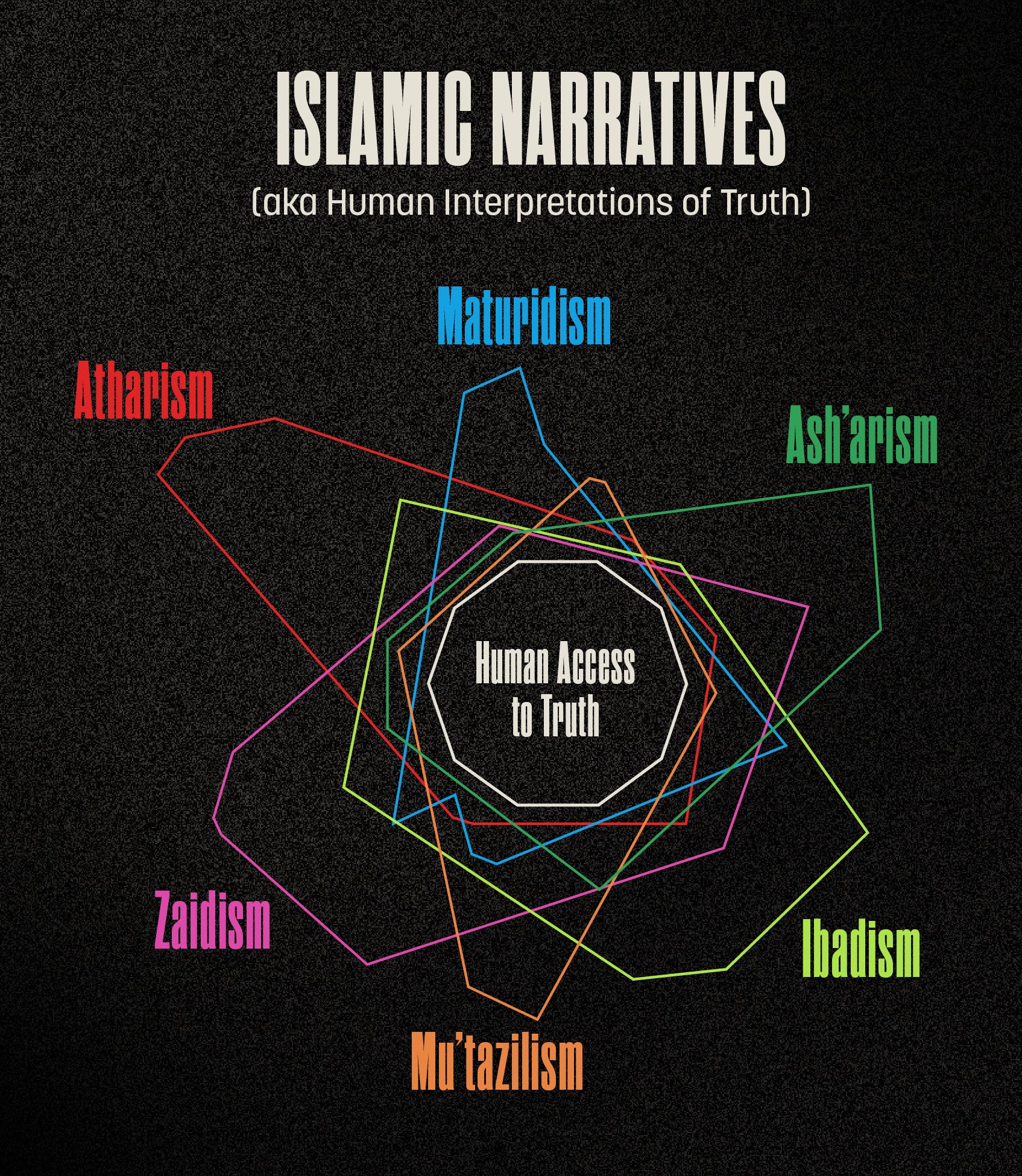
However, if the truth is known only to Allah, then what is falsehood? It has been stated that the schools and movements within Islam are attempts to grasp the truth, but none of them have been accused of falsehood. Our beloved Prophet Mohammed ﷺ was the last recipient of Prophetic revelation, and our Ummah, as intellectually diverse as we may be, preserved the essence of what he preached. So, then, what is false? If the cross-section of the truth that we got through him was a Decagon, then every polygon we produced encompassed that decagon. However, there were previous ummahs that didn’t preserve the message of the Prophets they claimed to follow. The Samaritans accept the Prophet Musa, but they reject Dawud. The Rabbinical Jews may accept Dawud AS and many after, but they don’t accept Yahya AS. The Mandaeans may accept Yahya AS, but they reject his nephew Isa AS. The Christians may accept Isa AS, but they reject the final Prophet Muhammad ﷺ. Not only did these 4 abrahamic faiths refuse to accept theProphets that came, but they also diverged from the message of the Prophets that came to them. Their reconstructed polygon did not include the decagon of revelation.
Now, one may bring up the objectiveness of logic, of reason, of various methods of inquiry, but he or she should be told that the human capacity to reason is limited by the human experience. When a German artist was tasked with drawing an elephant, a creature he’d never seen, he essentially drew a giant horse with a longer nose, because he had experienced a horse and size-differences. Imaginary creatures tend to be a combination of descriptions of actual things we’ve experienced. The earliest mythological portrayals of what we describe as a dragon was a serpent. The standard portrayal today is serpentine with characteristics of lizards and felines. We’ve seen a teapot, we’ve experienced orbits, and we see paintings of Mars, so it’s easy for us to imagine a teapot orbiting Mars. If our imagination itself is based on our experiences, so is our reason.
Our experiences give us specific worldviews, and impact how we view Islam itself, and how we convince those around us to adopt our understanding of islam. With our own reason, we develop our own thoughts, an individual effort, but then we are faced with “proving”— which is a collective phenomenon. The concept of “proof” and “proving” is not necessarily an individual phenomenon but a collective one, i.e. a singular individual can convince himself of anything, but it’s something else for him to convince another. A man alone on an island can easily convince himself of anything using principles he can concoct out of anywhere, because the only refutation he’ll get is from the angel of death. If you haven’t caught on by now, I have severe autism. So over the centuries, over millennia, humans have been figuring out how to “prove” something, i.e. how to come up with argooments that fellow humans are unable to refute. How to come up with principles that others can agree upon to derive more agreed-upon truth-claims. This millennia-long process seems to have culminated in a study called “logic”. So, logic is just as much a result of human experiences as reason is, logic just involves more people.
One may also ask: What about the existence of revelation? Can’t we read the Quran and derive the whole truth from it? While Revelation is the intersection between dimensions, the cross-section of the objective truth available to humanity, our interpretation of the text is a human effort. The fact that ardent followers of what Allah revealed through his Prophet and what his prophet told us still differ in interpreting and understanding what they follow shows the humanness of interpretation and understanding.
What we must in the end realize is that only Allah knows the Truth. The Truth is the knowledge of Allah. The truth of what is, of what is not, and what cannot be, and what is beyond this is known to none except Allah, and all we have is what He allowed us to know and our human attempts to develop beyond that. The attempts to reconstruct what exists beyond us is invigorating, as well as needed in many contexts, but we must refrain from acting like we’ve reached the Absolute Truth through our human effort, and from censuring those who formulate different conceptions of reality. We must instead encourage healthy dialogue between our various positions of truth, for the Truth is known only to Allah.
As Allah says in the Quran, “وَفَوقَ كُلِّ ذي عِلمٍ عَليمٌ” “But above those ranking in knowledge is the One All-Knowing.”
And indeed, Allah knows best.
Disclaimer: Material published by Nuun Collective is meant to foster inquiry and rich discussion. The views, opinions, beliefs, or strategies represented in published media do not necessarily represent the views of Nuun Collective or any member thereof. This particular work is satire.